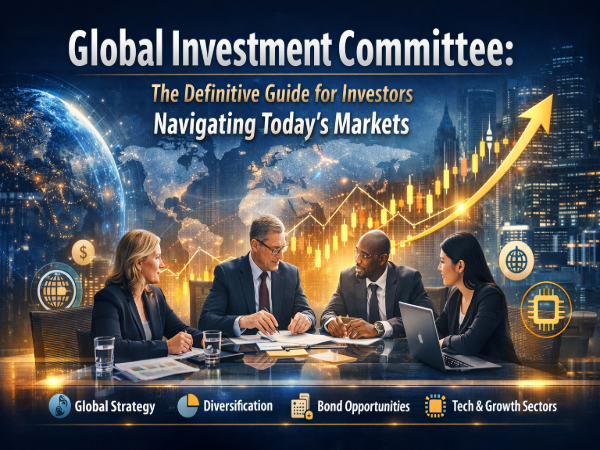
A Global Investment Committee (GIC) is a strategic leadership body within major financial institutions that evaluates global economic trends, asset classes, and market risks to formulate cohesive investment strategies. By combining insights from research analysts, portfolio managers, economists, and senior strategists, a GIC empowers investors with diversified, forward‑looking approaches to asset allocation. Whether navigating resilient economies, high bond yields, or technology‑led growth sectors, the Global Investment Committee’s guidance helps align portfolios with long‑term objectives while managing risk effectively.
Introduction: Understanding the Global Investment Committee
Investing in today’s global markets requires more than intuition. It demands structured analysis, macroeconomic insight, and strategic foresight. A Global Investment Committee provides all of this — acting as a centralized decision‑making hub that guides how capital is allocated across regions, asset classes, and market environments.
In this comprehensive guide, we’ll explore:
What a Global Investment Committee is
How it functions
Why it matters to both institutional and individual investors
Key strategies, trends, and verdicts from recent GIC outlooks
Practical ways to use GIC insights to optimize your investment decisions
This article is crafted to help readers truly understand the role of a Global Investment Committee and apply its principles in their own investment planning.
What Is a Global Investment Committee?
A Global Investment Committee is an internal body within financial organizations — such as major banks, asset managers, private wealth firms, pension funds, and sovereign investment entities — charged with determining the strategic course of investment portfolios on a global scale.
Unlike individual analysts or external newsletters, a Global Investment Committee:
Combines expertise from multiple disciplines
Reviews real‑time market data and economic forecasts
Sets macro and micro level priorities
Influences decisions for billions (or trillions) of dollars in assets
The outcome of their deliberations forms a Monthly View Summary, House View Outlook, or Quarterly Strategy Report, which institutional clients and advisors use to guide investment decisions.
Think of a Global Investment Committee as the brain of strategic asset allocation — ensuring diversified, disciplined, and forward‑thinking investment approaches.
Why the Global Investment Committee Matters
In a world of information overload, noise, and conflicting signals, investors need clarity and structured insights. The Global Investment Committee serves three vital roles:
Macro Outlook and Economic Forecasting
By synthesizing data on inflation, GDP growth, unemployment, and monetary policy, a GIC helps investors anticipate economic shifts. Understanding macro trends is essential for positioning portfolios before markets fully price in changes.
Asset Allocation and Risk Management
Asset allocation — deciding how much to invest in stocks, bonds, commodities, and alternatives — is the core function of a GIC. Allocation is guided by risk tolerance, expected returns, and diversification benefits.
Strategic Investment Guidance
Rather than react to short‑term volatility, GICs advise on strategic themes like:
Technology disruption
Emerging market growth
Interest rate environments
Sector rotations
Currency fluctuations
These strategic narratives help investors stay ahead of market cycles.
Core Functions of a Global Investment Committee
A Global Investment Committee is not an advisory afterthought. It executes critical functions that directly influence investor outcomes.
Evaluating Economic Trends
Members of a GIC continuously analyze key economic indicators such as:
Inflation rates
Central bank policies
Consumer spending trends
Employment data
Corporate earnings
This information determines whether markets are poised for expansion, contraction, or transition.
Asset Class Positioning
A fundamental task is determining how to weight investments across major asset classes:
Equities: Which regions or sectors offer growth?
Fixed Income: How should bonds be positioned amid changing interest rates?
Alternative Investments: Are assets like private equity, real estate, or commodities viable diversifiers?
Cash and Liquidity: What role should preservation play during uncertainty?
These decisions impact everything from pension portfolios to wealthy individual accounts.
Risk Management and Scenario Planning
A GIC looks at potential market shocks — such as geopolitical tensions, recession risks, or sudden inflation spikes — and builds scenarios to stress‑test portfolios. This forward‑planning protects capital and enhances resilience.
Regional and Sectoral Insights
Markets don’t move in unison. A strong GIC breaks down performance drivers across:
North America
Europe
Asia Pacific
Emerging Markets
It identifies where growth is sustainable, cyclical, or slowing, helping investors focus their exposure.
Key Themes from Recent GIC Outlooks
Let’s examine trends that have emerged from the latest investment committee reports, including the May 2024 Monthly View Summary, to understand how strategic priorities are evolving.
Resilience of Major Economies
Despite global uncertainties, major economies such as the United States and parts of Western Europe have demonstrated remarkable resilience. Consumer spending remains solid, corporate balance sheets are strong, and job markets have resisted downturn pressures.
This resilience shapes a GIC’s bullish stance on select equities, especially where earnings growth is supported by robust fundamentals.
Interest Rates and Fixed Income Opportunities
After years of ultra‑low interest rates, central banks shifted toward tightening to curb inflation. While rate cuts may be delayed, higher yields in fixed income markets are attractive.
The Global Investment Committee recognizes that:
High‑quality bonds offer strong income
Duration risk is manageable with tactical duration positioning
Emerging market debt can provide yield enhancement
This has led to recommendations that balance growth (equities) with yield (fixed income) — a hallmark of risk‑aware strategies.
Technology and Innovation‑Led Growth
Technology continues to drive growth in global markets:
Artificial intelligence and machine learning adoption
Cloud computing expansion
Digital transformation across industries
The GIC emphasizes technology and communications sectors as engines of long‑term returns — supported by secular trends and digital economy adoption.
Diversification Through Multi‑Asset Strategies
Diversification is not simply about owning different securities. A robust GIC advocates multi‑asset strategies that include:
Traditional equity and fixed income
Alternative investments
Commodities and real assets
Risk‑managed solutions such as volatility strategies
This holistic approach reduces concentration risk and smooths portfolio returns over time.
Regional Growth Opportunities
Different parts of the world display unique investment characteristics:
Asia Pacific
Asia is positioned for structural, long‑term growth. Countries like India benefit from demographic trends, reform agendas, and domestic consumption.
Developed Markets
Developed economies continue to offer stability and liquidity — appealing to investors seeking balance with growth potential.
By highlighting varied regional dynamics, a Global Investment Committee ensures investors don’t overlook compelling opportunities outside their home markets.
How the Global Investment Committee Approaches Portfolio Construction
A core question for investors is: How do GIC insights translate into actual portfolios?
Strategic Asset Allocation
This is a long‑term blueprint that defines how investors should proportionally allocate capital across major asset buckets. It reflects:
Risk tolerance
Return expectations
Time horizon
Strategic allocation is periodically reviewed by the committee to adapt as global conditions evolve.
Tactical Adjustments
In addition to the long‑term view, the committee may recommend short‑term tactical moves, such as:
Overweighting specific sectors
Shifting exposures based on interest rate expectations
Increasing cash positions amid volatility
These tactical decisions are grounded in data and intended to capitalize on transient opportunities.
Risk Controls
A sophisticated GIC embeds risk limits — such as maximum drawdown thresholds or volatility tolerance — to protect portfolios against adverse outcomes.
Risk management ensures that investment decisions are not only ambitious, but also resilient under stress.
Real‑World Impacts of Global Investment Committee Decisions
Some people assume the work of a Global Investment Committee is only relevant to institutional investors. In reality, their influence extends across the entire investment ecosystem.
For Financial Advisors
Advisors use GIC insights to:
Educate clients on market conditions
Adjust client portfolios preemptively
Justify strategic decisions with data‑backed reasoning
For Individual Investors
Even retail investors benefit indirectly:
Understanding macro trends improves decision‑making
Diversification strategies limit risk
Awareness of growth themes helps guide stock selection
For Wealth Management Platforms
Platforms often incorporate GIC guidance into:
Model portfolios
Target risk solutions
Investment research commentary
This amplifies the reach of the insights far beyond the original committee.
Common Misconceptions About the Global Investment Committee
Despite its importance, a few myths persist:
It Predicts Markets Perfectly
Truth: A Global Investment Committee does not forecast markets with certainty. It provides the most informed outlook possible, but markets are inherently uncertain.
It Is Only for Large Institutions
Not true. While GICs operate within large firms, their published insights influence all levels of investors — including advisors and individual traders.
It Makes All Investment Decisions for Clients
Clients retain autonomy. A GIC informs and guides decisions, but individual investors and advisors ultimately choose how to apply those insights.
How to Apply GIC Insights to Your Own Investing
To leverage the power of a Global Investment Committee, consider the following practical steps:
Follow Monthly or Quarterly Views
Regularly review GIC outlooks from reputable institutions to understand changes in macro positioning.
Align With Your Risk Profile
Match committee recommendations with your own risk tolerance — conservative, moderate, or aggressive.
Diversify Across Assets
Don’t rely solely on one asset class. Embrace equities, bonds, alternatives, and strategic cash.
Think Long‑Term
Committees often emphasize structural themes — such as demographics or technological adoption — that play out over years.
Adjust Tactically When Justified
While long‑term strategy matters, temporary market dislocations can create opportunities.
Future Trends That GICs Are Watching
Forward‑thinking Global Investment Committees are increasingly focused on:
Sustainability and ESG Integration
Environmental, Social, and Governance factors are reshaping capital flows as investors demand purpose alongside performance.
Technology Transformation
AI, automation, and digital infrastructure will remain central growth drivers.
Demographic Shifts
Aging populations in developed markets and youthful labor forces in emerging markets influence consumption patterns.
Monetary Policy Evolution
Central banks will continue experimenting with policy responses to inflation and growth dynamics.
By tracking these trends, investors can stay ahead of the curve.
Conclusion: The Strategic Value of the Global Investment Committee
The Global Investment Committee is more than a committee — it’s a strategic brain center that synthesizes economic insight, investment research, and risk analysis to guide capital deployment in global markets.
From setting broad asset allocation frameworks to highlighting tactical opportunities, a GIC helps investors:
Navigate complexity
Balance risk and reward
Capitalize on long‑term growth themes
Mitigate volatility through thoughtful diversification
For both seasoned professionals and everyday investors, understanding and applying the principles developed by a Global Investment Committee is essential to building resilient, future‑ready portfolios.