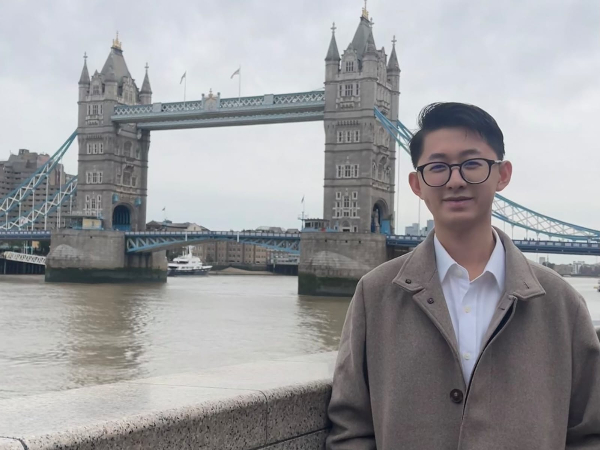
On the evening of Friday, 20th March 2026, the Union of Young Sociologists of Eastern England conducted a written interview with Mr. Ly Kimlong, a Cambodian young sociologist, often described as “the young Cambodian prodigy”. The following is the written interview.
What first sparked your interest in sociology?
I became interested in sociology back when I was 10 years old. In a way, I always wanted to understand how societies shape people’s lives. Growing up in Cambodia, I saw how family, community, education, and economic opportunities can influence someone’s future. Sociology gave me the tools to study these issues and ask why some groups thrive really well while others struggle.
Are there any sociologists who have strongly influenced your thinking?
Yes, I have been inspired by thinkers like Walter Benjamin, whose ideas about culture and modernity offer very thought-provoking ways to understand societies. Karl Marx is another thinker that I really respect. His works are very influential, and they examined how economic systems shape the social relations and inequality.
Why is sociology important for understanding your country?
Sociology in general helps us see the larger patterns behind everyday life. In Cambodia, it can explain how the education systems, rural-urban migration, or the economic development affect every family and community. Through studying these underlying patterns, we can better understand how the country of Cambodia is changing and how to address the many social challenges. So, yeah, I think sociology is very important.

What social issue in Cambodia do you think deserves more attention?
One issue that I think deserve more attention, is the massive gap between urban and rural opportunities. Big cities like Phnom Penh are developing rapidly, but many rural communities still face limited access to education, healthcare, and economic opportunities. For example, in the provinces, healthcare services can be very hard to reach and on top of that there are fewer facilities and qualified doctors. From a sociological perspective, these differences shape people’s life chances in very profound ways. I think more studies into these inequalities, how they developed, how they affect communities, and how people adapt to them, could help the government better understand the realities on the ground and design better solutions. I am all for a more balanced and inclusive Cambodia.
Do you think young people in Cambodia are changing society?
Yes, I think the young Cambodians are playing an important role in social change. With greater access to education, technology, and exposure to foreign ideas, young people are questioning traditional expectations and are exploring new ways to contribute to the country.
I really hope to see a more open, creative, and socially engaged generation emerge. I am also very positive about this social change
What are you currently researching or most curious about? Currently, I am particularly curious about how globalisation and digital technology are changing social identities in Cambodia. Social media, migration, and international education are influencing young Cambodian people in how they view themselves and their future. However, I have to be honest, urban sociology is still my number one passion, and if money were not really a concern, I would dive much deeper into this subfield of sociology. I am really interested in applying the concept of the urban flaneur to study the streets of Phnom Penh, Cambodia.
What misconceptions do you think people often have about sociology?
I think some people think that sociology is just simple “common sense,” but no. Sociology uses research methods and data to understand social patterns. Sociologists collect evidence, analyse trends, and test theories to explain why societies behave the way they do. Sociology is not philosophy, as some of my friends have always told me.
Are you working on any new essays or research at the moment? Yes, I am currently working on a writing which I hope to turn into a book in the future. I hope this one will receive the same reception as with other writings that I have publicly shared and published.
We would like to thank Mr. Ly Kimlong for accepting our interview and sharing his insights and views on our question.