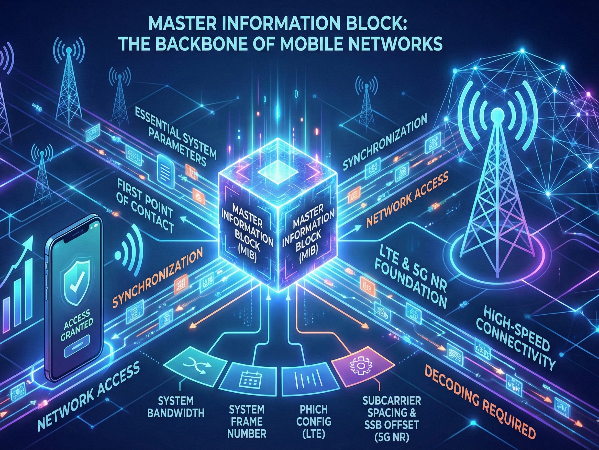
The Master Information Block (MIB) is one of the most critical elements in modern mobile communication systems such as LTE (Long-Term Evolution) and 5G NR (New Radio). Serving as the first point of contact between a mobile device and a cellular network, the MIB contains essential system parameters that every user equipment (UE) must decode before gaining access to the network. From synchronization to system bandwidth and configuration settings, the MIB ensures that devices can seamlessly communicate with base stations, providing the foundation for high-speed, reliable, and efficient mobile connectivity. Without the MIB, a mobile device would lack the necessary information to locate additional system messages, making network access impossible.
Introduction to Master Information Block
In the realm of mobile communication, the Master Information Block acts as the cornerstone that allows a mobile device to establish its first connection with a network. Whether it is LTE or 5G NR, the MIB contains a minimal yet vital set of system parameters that enable the user equipment (UE) to synchronize with the base station. It is the very first piece of information that a mobile device decodes upon entering a new network area. By doing so, it forms the backbone for further system information decoding, enabling seamless communication, high data throughput, and low latency connections.
The MIB is particularly important because it ensures that any device entering the network area, whether it is a smartphone, tablet, or IoT device, can immediately understand the basic operational parameters of the network. This includes knowledge of the system bandwidth, frame structure, and how to locate additional system information, which are essential for successful network access.
The Importance of MIB in LTE and 5G
The Master Information Block is indispensable in both LTE and 5G networks. It acts as the first building block for a device to interact with the network. In LTE, the MIB provides essential parameters like system bandwidth, Physical HARQ Indicator Channel (PHICH) configuration, and system frame number, which are crucial for the UE to understand the network’s frame structure and timing. In 5G NR, the MIB includes advanced parameters such as subcarrier spacing, SSB (Synchronization Signal Block) offset, and pointers for further system information blocks.
Without the MIB, devices would be unable to synchronize or decode the network’s system information. This would lead to failed network access attempts, dropped connections, or inability to transmit or receive data efficiently. In essence, the MIB is the key that unlocks all subsequent communication between the device and the base station.
Components of Master Information Block
The MIB may appear simple at first glance, but it carries critical system parameters. Understanding its components helps explain why it is so vital.
System Bandwidth
System bandwidth refers to the total frequency range allocated to a network cell. In LTE, this is expressed in terms of Resource Blocks (RBs), and in 5G, it is often paired with subcarrier spacing. The system bandwidth informs the UE about the spectrum it can use for both uplink and downlink communication. Correctly decoding this parameter ensures that devices can efficiently utilize the network’s resources without causing interference.
System Frame Number
The system frame number (SFN) is a timing reference that allows the UE to synchronize its internal clock with the network. By knowing the SFN, a device can determine when to transmit and receive data, as well as how to align with the network’s frame structure. In LTE, the MIB typically carries part of the SFN, while in 5G, the MIB carries the most significant bits of the SFN.
PHICH Configuration (LTE Specific)
The Physical HARQ Indicator Channel (PHICH) is a unique element in LTE that handles uplink acknowledgments for data transmissions. The MIB contains configuration details for PHICH, such as duration and resource multiplier, which are essential for devices to understand how to respond to network transmissions. Correct decoding of PHICH parameters ensures reliable communication and proper error handling.
Subcarrier Spacing and SSB Offset (5G NR Specific)
In 5G NR, the MIB includes subcarrier spacing and SSB offset. Subcarrier spacing is crucial because 5G supports multiple numerologies, ranging from 15 kHz to 120 kHz, allowing flexibility in data transmission. The SSB offset provides information on where to locate the synchronization signal block in frequency, enabling devices to identify the correct beam and decode the MIB properly. These parameters are unique to 5G and demonstrate the adaptability of MIB in next-generation networks.
Transmission of MIB
MIB in LTE
In LTE, the MIB is transmitted over the Physical Broadcast Channel (PBCH), which is mapped from the Broadcast Channel (BCH). It is typically transmitted in subframe 0 of each radio frame and is repeated periodically to ensure reliability. PBCH uses QPSK modulation and occupies the central six resource blocks of the downlink carrier. The periodic transmission ensures that even if a UE misses an initial attempt to decode the MIB, it can still catch the next one, ensuring seamless access to the network.
MIB in 5G NR
In 5G NR, the MIB is embedded within the SS/PBCH block, alongside synchronization signals (PSS/SSS). This design allows devices to simultaneously acquire timing synchronization and critical system information. The MIB is broadcast over multiple beams in an SS burst set, accommodating the beamforming capabilities of 5G. This ensures that devices in different locations within a cell can access the network efficiently, even in mmWave or high-frequency deployments.
How MIB Enables Device Synchronization
Synchronization is a critical step in connecting a device to a mobile network. The MIB provides the essential parameters that allow the UE to align its timing with the network’s frame structure. By decoding the system frame number and other configuration parameters, the UE can determine when to transmit and receive signals, locate the control channels, and prepare to decode further system information blocks. Without this initial synchronization, communication would be unreliable, resulting in dropped calls, slow data speeds, and inefficient spectrum use.
Differences Between LTE MIB and 5G NR MIB
While the core purpose of MIB remains the same in LTE and 5G NR, there are notable differences in its structure and content:
| Feature | LTE MIB | 5G NR MIB |
|---|---|---|
| Transmission Channel | PBCH | SS/PBCH block |
| Key Parameters | System bandwidth, PHICH config, SFN | System bandwidth, subcarrier spacing, SSB offset, SFN MSBs |
| Modulation | QPSK | QPSK with beamforming support |
| Role | Synchronization and initial access | Synchronization, beam-aware access, flexible numerology |
| Periodicity | 10 ms | Aligned with SS burst set (varies) |
These differences highlight how 5G has evolved to support more flexible, high-speed, and low-latency communications, while still relying on the foundational concept of the MIB.
Role of MIB in System Information Block (SIB) Acquisition
After decoding the MIB, a UE can locate and decode the next set of system information blocks, typically starting with SIB1. SIB1 contains more detailed information about the cell, including RACH configuration, cell access parameters, and other essential data for establishing a stable connection. The MIB essentially serves as a guide for the UE, pointing it toward additional information needed to communicate effectively with the network.
Challenges in MIB Transmission and Decoding
Despite its simplicity, transmitting and decoding the MIB comes with challenges:
-
Signal Fading and Interference: Poor signal conditions can cause the UE to fail in decoding the MIB, delaying network access.
-
Beamforming in 5G: In mmWave frequencies, beamforming creates directional beams. The UE must identify the correct beam to decode the MIB successfully.
-
Multiple Numerologies in 5G: Devices must interpret subcarrier spacing correctly, or synchronization errors may occur.
-
Mobility: Rapidly moving devices, such as in vehicles, may experience difficulties in consistently decoding the MIB.
Addressing these challenges is critical for ensuring reliable and seamless connectivity in both LTE and 5G networks.
Future of MIB in Evolving Mobile Networks
As mobile networks continue to evolve toward 6G and beyond, the MIB will remain a fundamental element of network access. Future improvements may include enhanced error correction, more efficient broadcasting techniques, and adaptive transmission based on network conditions. Additionally, as IoT devices proliferate, MIB design may evolve to support ultra-low-power devices while maintaining high reliability for mobile communication.
Conclusion
The Master Information Block is undeniably the backbone of LTE and 5G networks. By providing essential system parameters, it enables devices to synchronize, locate system information, and establish reliable communication with base stations. Despite its small size, the MIB carries critical information that supports network efficiency, reliability, and speed. Understanding its structure, transmission, and role in mobile networks is essential for anyone studying or working in the field of mobile communication. As networks continue to advance, the importance of the MIB will only grow, ensuring that every device can seamlessly access and communicate within increasingly complex mobile environments.