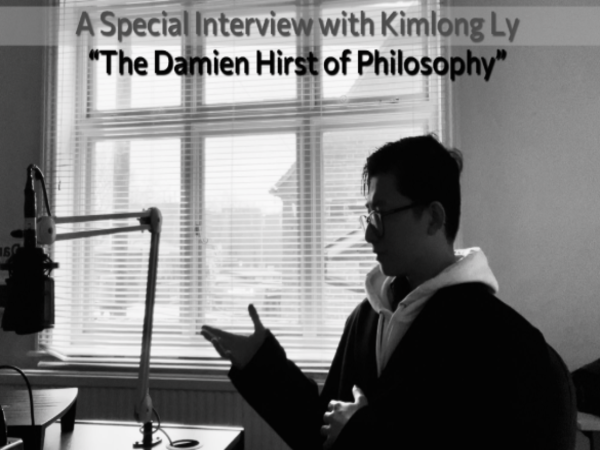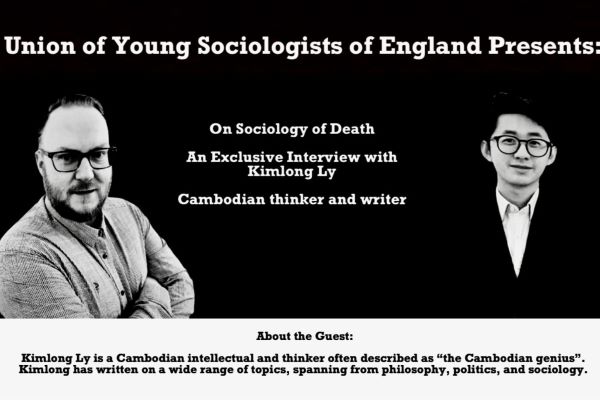
Death is often treated as a biological event, but sociology reveals something deeper: death is also a social fact. The Union of Young Sociologists of England, conducted an interview with Kimlong Ly, a Cambodian intellectual and thinker often described as “the Cambodian genius”. Kimlong has written on a wide range of topics, spanning from philosophy, politics, and sociology. This is the second interview with Kimlong.
In your view is death a biological reality or a social construction?
Kimlong: Death starts as a biological reality, but it becomes meaningful through social construction. The body stops function that is a biological reality, but the significance of that event is entirely dependent upon the different culture. Different culture and societies define a good, a tragic, or an honourable death in different ways. Nobody escapes death of course, but every society teaches its members different how to understand and deal with it. Death is universal but also culturally manufactured.
Why do modern societies seem uncomfortable discussing about death?
Kimlong: I do not think so. I think it depends on the where and when. However, I do think that since the modern society has the illusion that technology can fix everything, societies often fall into the illusion that every problem can be solved. I would also like to add that death has become increasingly institutionalised. People moved into hospitals, to nursing homes, and specialised industries. This is a good illustration of McDonalisation of Society but through the example of Death.
What do you think about of funerals?
Kimlong: For me, funeral rituals are not entirely for the dead but also for the living. They reveal many things about societies such as values, inequalities, collective beliefs, and power structures. The way the community mourns also tells us how it understands family, religion, and memory.
Why do some deaths become public tragedies while others remain invisible?
Kimlong: Well, not all deaths have equal social visibility. People of higher status or worth to society become publicly mourned. It is because of this that a celebrity death may receive global attention, while thousands of deaths caused by poverty, by wars and by illnesses remain invisible.
Do you think social media transformed the meaning of death?

Kimlong: I do. For most of human history, memory was localised. Today, through the many digital platforms create a place of social immortality. Profiles remain although the people are gone. They are biologically absent but digitally present. This is probably one of the strangest developments in human history. A true marker of the new digital world.
Do you think inequality persist even after death?
Kimlong: Death is universal, but dying is very unequal. Access to healthcare, end-of-life care, funeral services, inheritance, and even memorialisation varies dramatically according to the class, race, gender, and geography of the person. Some individuals receive statues and monuments. Some receive smaller memorials. Others disappear without records. Sociology reminds us that even memory itself is socially distributed.
What is the most important sociological lesson that death teaches us?
Kimlong: Death reveals that individuality and society are inseparable. A person’s death is never just a personal event. It has wider impacts. It affects families, communities, institutions, and historical memory. Sociology teaches us that our lives gain meaning through relationships, and death exposes the depth of those connections. Ultimately, death is not only about endings. It is also about continuity. Our values, fame, stories, identities, and social bonds continue beyond individual existence.
So a final question to you Kimlong, do you fear death?
Kimlong: Unfortunately, yes. I wish I can say no but that would be lying. However, I want to end this interview by saying that through studying sociology of death, I recognise that significance comes from contribution to society rather than duration.
We would like to thank Mr. Kimlong for accepting our interview and sharing his insights and views on our question.